The hybrid team: how I'd organise humans and agents around the customer
Every craft now has its own AI agent. Here's how I'd organise humans and agents around the customer lifecycle, so the output still tells one story.
In short
- Let the customer lifecycle lead, with two motions: new business and existing customers.
- Two central agents (Context and Operations) serve five that work the lifecycle as one squad.
- Every agent domain has one accountable human, and every tool has one home.
For most of my career as a CMO in European B2B SaaS, I organised marketing the same way: around the customer. Multidisciplinary teams, working the stages of the customer lifecycle: brand building, demand creation, demand capture, and retention and expansion.
It worked because everyone around the table could see the whole journey. The copywriter sat next to the campaign manager. The growth marketer heard what sales was struggling with. Product marketing kept the story straight.
Now every one of those crafts has its own AI tools. And in almost every company I speak with, I see the same pattern: each craft adopts its own agent, each agent gets its own version of the strategy, and the output starts pulling in different directions. Faster than ever.
Each agent gets its own version of the strategy, and the output starts pulling in different directions. Faster than ever.
So the question I keep getting from founders and marketing leaders is a practical one: how do you organise a team of humans and agents? Here is how I think about it.
Let the lifecycle lead
Before you assign a single agent, start with the customer lifecycle and the two go-to-market motions that run across it:
- New business: marketing and sales together, across brand building, demand creation and demand capture.
- Existing customers: marketing and customer success together, across brand building and retention and expansion.
Brand building serves both motions: your customers need to keep choosing you as much as new buyers need to remember you. Both motions run all the time. Only about 5% of B2B buyers are in market in a given quarter.¹ The other 95% are deciding, slowly, which names they will remember. A team that only works the bottom of the funnel misses most of the market, and a team that forgets its customers leaks the revenue it already won.
Only about 5% of B2B buyers are in market in a given quarter. The other 95% are deciding, slowly, which names they will remember.
Two central agents, five that work the lifecycle
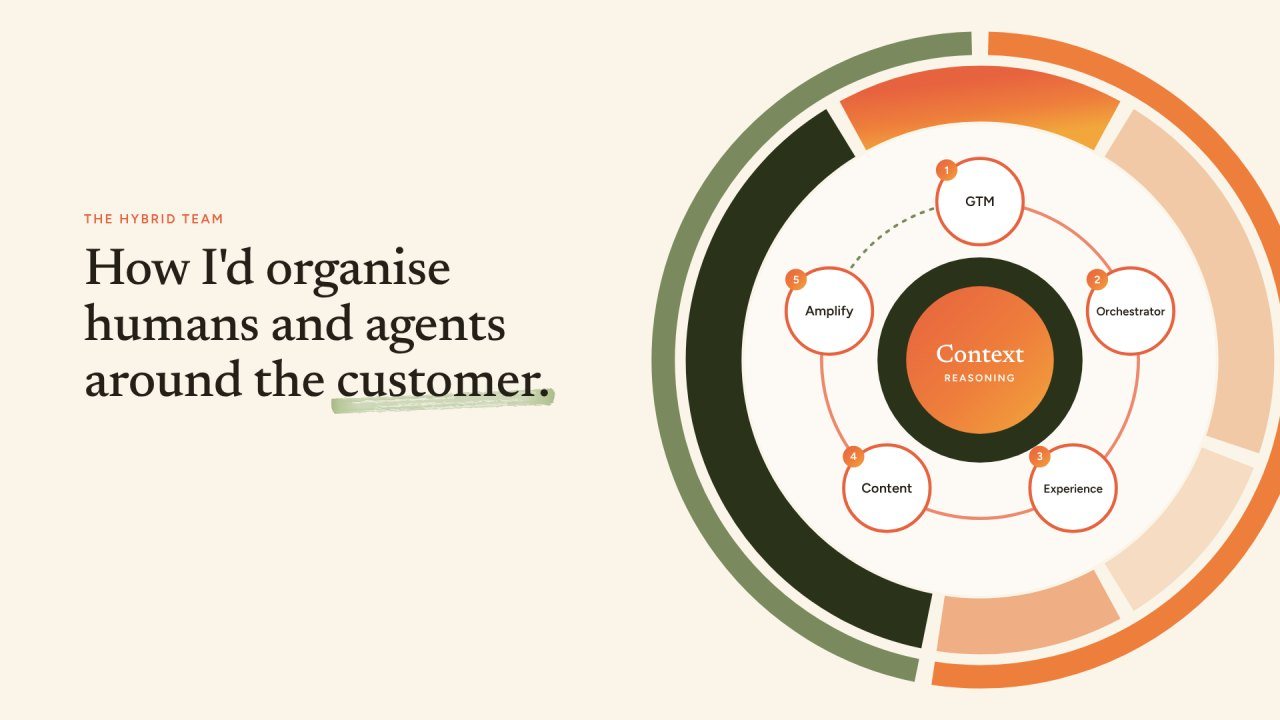
Here is the shape I would build today. Seven agent domains, each with a clear owner. Two sit at the core and serve everything. Five form one squad that always works together: on marketing campaigns and programmes for specific audiences, by region, industry and segment, aimed at a specific lifecycle stage.
The two central agents
- Context & reasoning agent (in the old world: strategy & product marketing). Your reasoning. It holds your strategy, narrative and messaging per persona, signed off by leadership, and every other agent works from it.
- Operations agent (in the old world: marketing operations). The engine. Data, workflows, connections between tools, measurement. It keeps the whole system running and honest.
The five multidisciplinary agents
- GTM agent (in the old world: joint business planning between marketing, sales and customer success leadership). Decides where to play: which segments, which accounts, which targets, for new business and for existing customers.
- Orchestrator agent (in the old world: marketing and campaign management). Turns the plan into programmes and campaigns, sequences them across the lifecycle stages and keeps them on schedule.
- Content agent (in the old world: editorial and copywriting). Writes the words: articles, emails, scripts, ads, sales and success material.
- Experience agent (in the old world: concepting and creative). Makes it look, sound and feel right: visuals, video, voice, landing pages.
- Amplify agent (in the old world: growth and digital marketing). Gets it seen: paid and organic distribution, search, AI visibility, outbound, and learning from what performs.
All five are needed for every programme and every campaign, whether it builds your brand, creates or captures demand, or helps existing customers grow. No single craft can carry a lifecycle stage on its own; that's why they work as one squad.
Be strict about accountability
This is where most hybrid teams go wrong. When an agent can do the work of three people, it becomes tempting to let accountability blur. I would do the opposite and make it sharper than ever.
Every agent domain has one accountable human. Agents are responsible for doing the work in between; humans are accountable for what goes out. In practice, I see three roles inside every craft:
- Creator (the why). Owns the idea, the story and the point of view. Decides what is worth making. The source of the brief.
- Operator (the how). Designs the workflow, runs the agents and owns the quality bar.
- Engineer (the what). Wires the stack: connections, prompts, evaluations. Makes it ship.
Agents run the cycles between those decisions: research, brief, draft, ship, measure. At a pace no human team can match. Humans set the hypothesis, judge the output and decide what is worth doing again.
In a smaller company, one person may hold all three roles for a craft. In a larger one, a team splits them. Either way, write down who holds which role. If nobody can answer "who decided this?", you have automation without ownership.
Give every tool a home
The tooling market is exploding, and most companies collect tools before they have decided who owns them. I find it helps to map every tool to exactly one agent domain. Business planning tools belong with GTM. A writing platform belongs with Content. Image, video and voice tools belong with Experience. Search, social and AI-visibility tools belong with Amplify.
When a tool has a home, it has an owner, a purpose and a place where its output is judged. And when every tool draws on the same Context, the output from ten tools still adds up to one story.
Where to start
If I were starting tomorrow, this is the order I would follow:
- Make your Context explicit first. Write down your strategy, narrative and messaging per persona, and have leadership sign it off. Every agent you add later inherits it. Every agent you add before it has to guess.
- Pick one motion and one stage. For most scale-ups, that's demand creation in the new business motion: the middle of the funnel, where buyers come to understand why you're different, long before they are in market.
- Name the humans. For each of the five multidisciplinary domains, decide who is the Creator, the Operator and the Engineer, even if one person holds several.
- Give your tools a home. Map what you already use to the seven domains before you buy anything new.
- Measure, then expand. Let the Operations agent show what works, then add the next lifecycle stage and the second motion.
This is how good marketing teams have always worked: close to the customer, multidisciplinary, clear about who owns what. The difference is speed. With agents, a team of five can do the work of fifty. But only if all fifty voices still tell the same story.
Your distinctive approach. At scale.
¹ Ehrenberg-Bass Institute for LinkedIn's B2B Institute, 2021.

Co-founder of Baaken. Follow on LinkedIn