What's the difference between strategy, story and narrative, and why does it matter now?
Strategy is a set of connected choices, a story is one closed unit of meaning, a narrative connects stories. Why the difference matters when AI writes: scaffolding judgement.
| What it is | Who owns it | What breaks without it | |
|---|---|---|---|
| Story | One closed account, with a beginning, middle and end | Whoever tells it | A single moment of attention |
| Narrative | A connected system of stories | The leadership team | Meaning drifts between teams and tools |
| Strategy | Connected choices on where to play and how to win | The leadership team | Effort spreads across too many bets |
| Positioning | Your place in the buyer's head, relative to alternatives | Marketing, signed off by leadership | Buyers file you next to the wrong alternative |
| Proposition | What the customer actually buys | Product and commercial leads | The promise and the delivery come apart |
Why does strategy need a narrative?
Strategy is a slippery word. A study in the Strategic Management Journal analysed 91 definitions of it, published between 1962 and 2008¹. In workshops with leadership teams, I see the same looseness up close: ask five leaders how their company wins and you hear five sensible answers that don't quite meet.
Ben Horowitz put the link plainly: "No, the story is the strategy. If you make your story better you make the strategy better."² Working on the story is working on the strategy, because it forces the choices into words.
What is the difference between a story and a narrative?
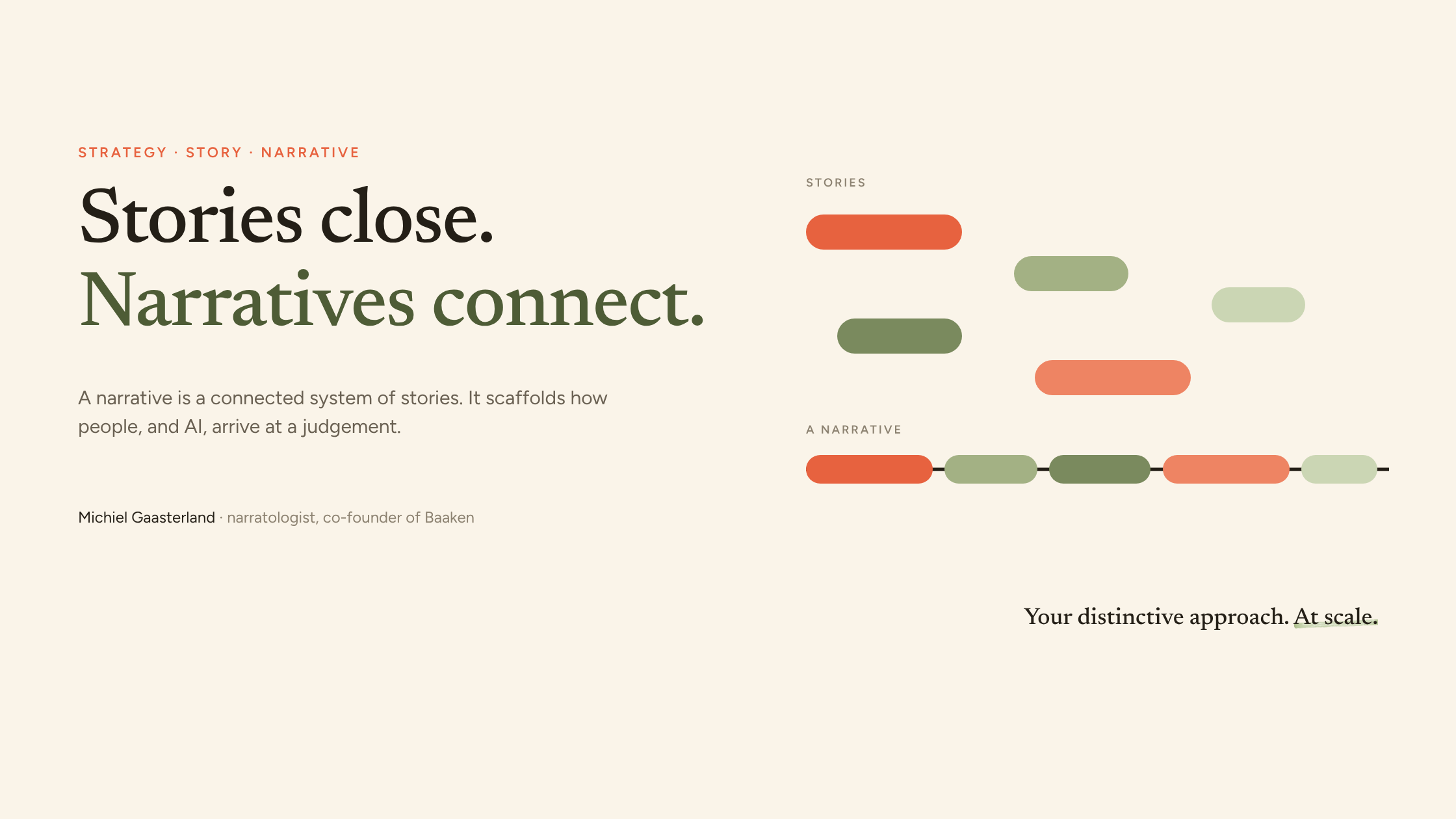
A story is a closed unit of meaning, usually with a beginning, middle and end. A narrative is a connected system of stories that organises perception, stabilises meaning, and invites participation and change. A case study is a story. The account of why your market is shifting, and why your way of winning fits that shift, is a narrative. Every case study, pitch and post should be readable as one chapter of it.
Words set the edges. Wittgenstein wrote that "the limits of my language mean the limits of my world"³. The vocabulary a company settles on decides what its people can see and argue about.
What is the difference between positioning and proposition?
Positioning is the place you occupy in the buyer's head, in relation to the alternatives. A proposition is what the customer actually buys: product quality, service, delivery and price. Teams often polish one and call it the other.
What is in a strategy?
Lafley and Martin describe strategy as a cascade of five connected choices: a winning aspiration, where to play, how to win, the must-have capabilities and the management systems that support them⁴. The heart of it is the second and third. Where to play sets the boundaries of competition: geography, customer segment, product category, channels and the part of the value chain you occupy. How to win is the theory for winning there. In workshops I break it into three parts: the distinctive approach, the superior outcome it gives customers, and the realistic alternative they would choose instead.
What is in a strategic narrative?
A strategic narrative carries those choices in six parts, a structure that builds on Andy Raskin's work on strategic narrative:
- The shift: the change in the buyer's world that alters what it takes to win.
- The stakes: what the buyer wins or loses by keeping the old way or moving.
- The promised land: how the buyer operates once it has won.
- The obstacles: what stands in the way, created by the shift.
- The gifts: what the buyer can now do to clear the obstacles, stated as capabilities, not features.
- The proof: comparable organisations that already got there.
Why does narrative matter more when AI writes?
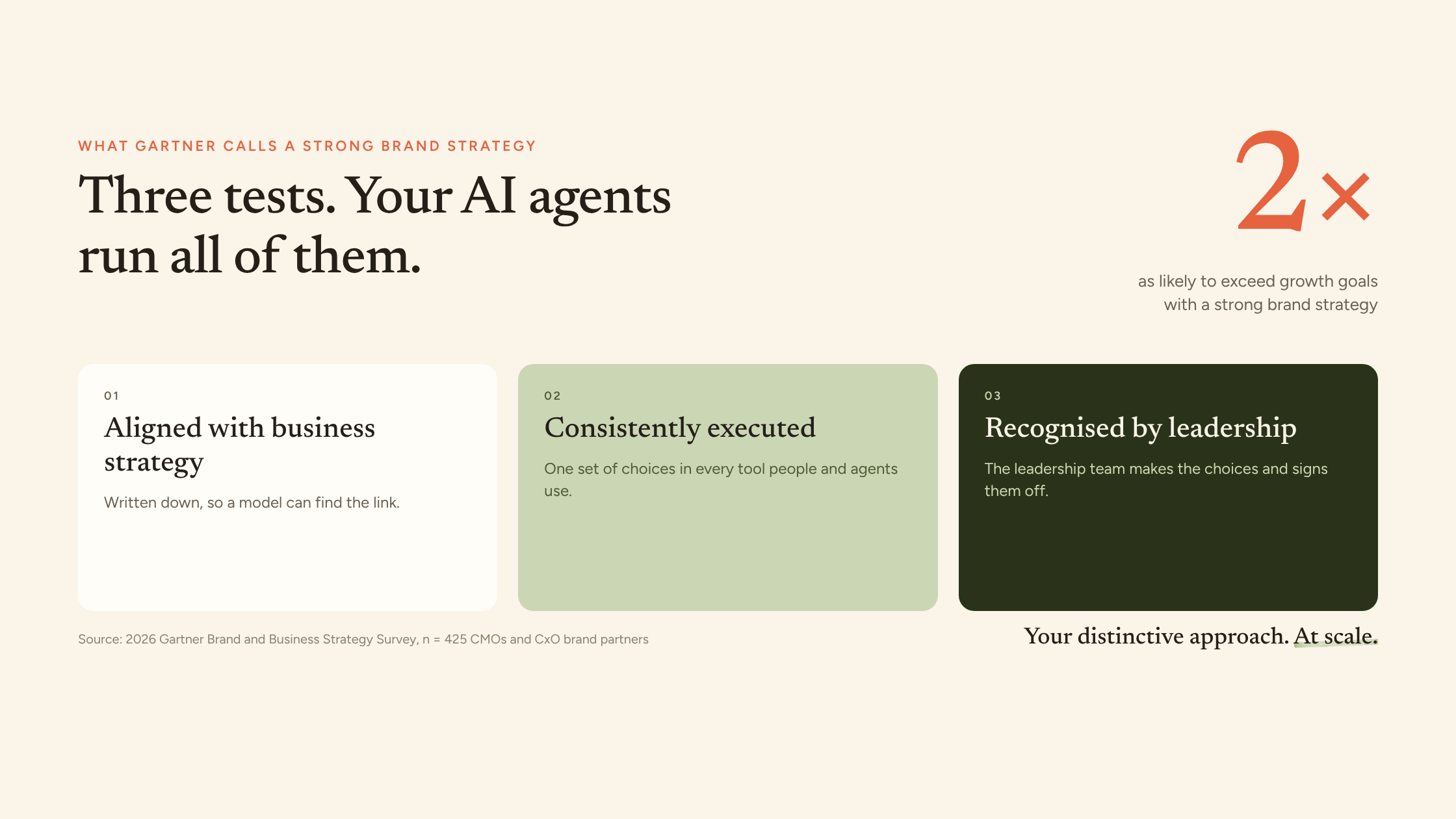
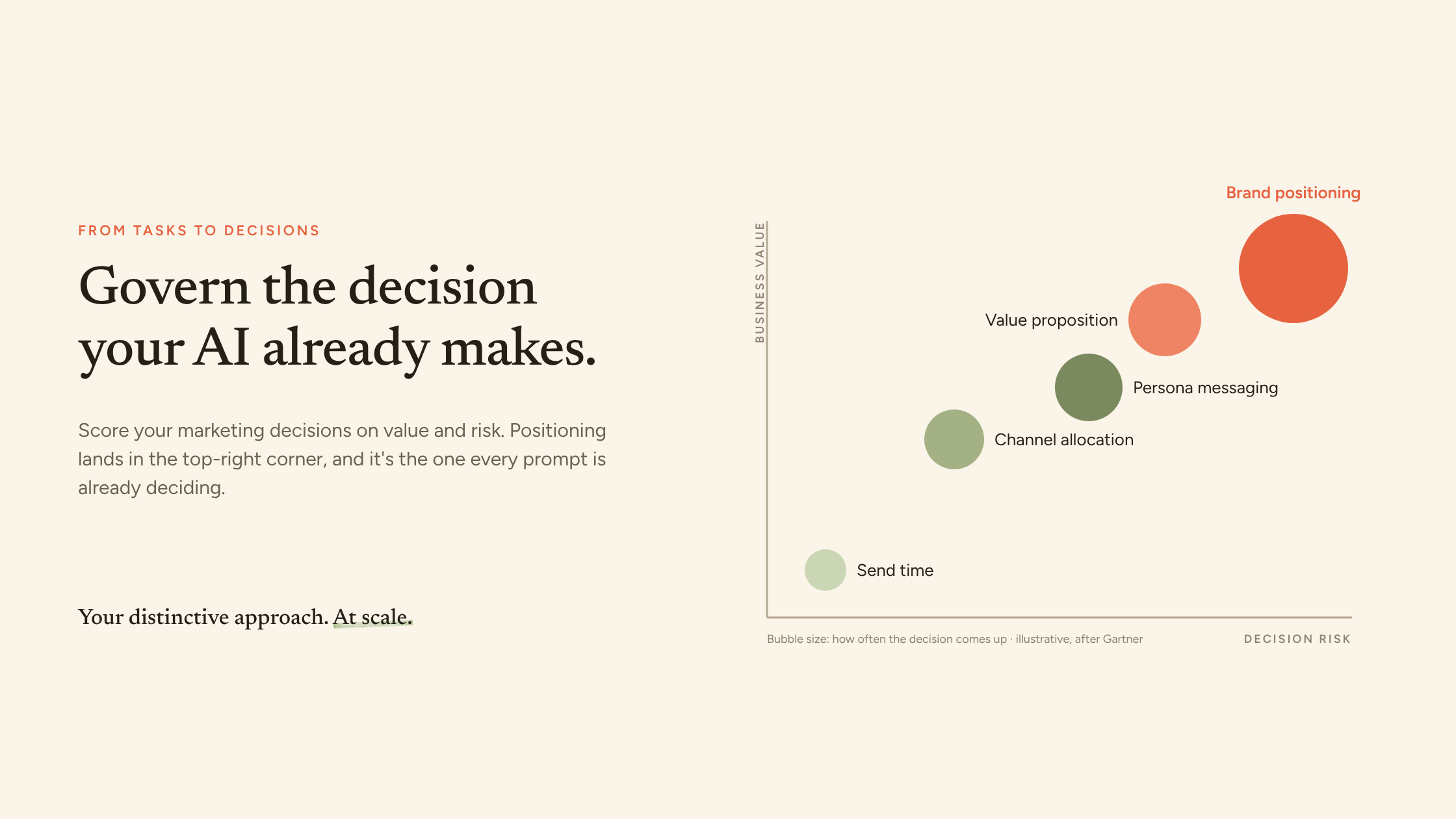
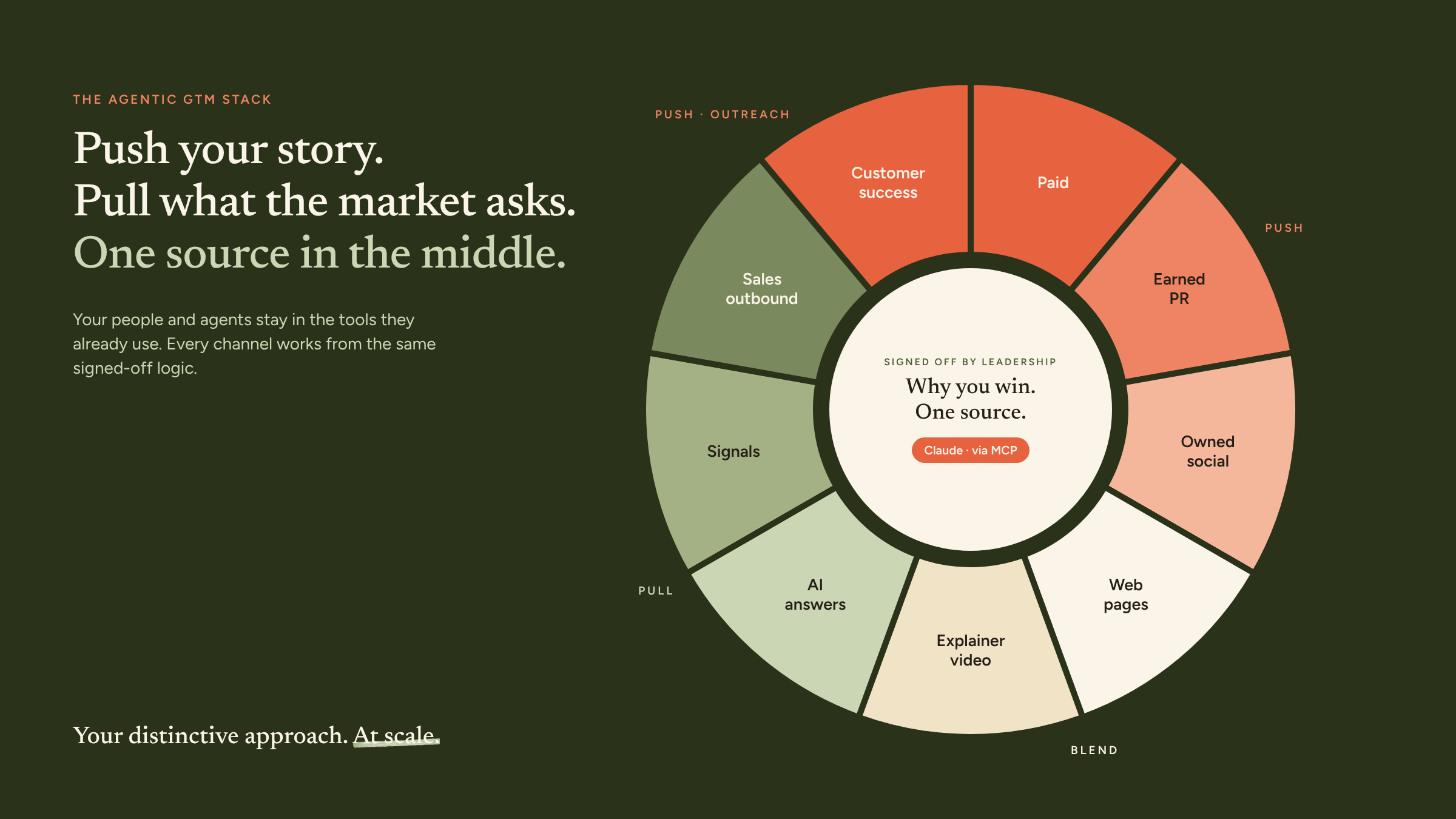
AI makes output cheap, so judgement becomes the scarce resource. A model turns incomplete company context into fluent copy and fills the gaps with assumptions of its own. A narrative nobody has decided gets rebuilt by every person and every tool, slightly differently each time. That's why the strategy and the narrative both need deciding. See what a GTM reasoning platform is, what a GTM brain needs and messaging framework vs signed-off strategy.
What does scaffolding judgement mean?
You can't tell people, or AI, what to think. You can scaffold how they arrive at a judgement. That scaffold is a signed-off strategy and narrative that everyone works from, so a sales rep, an agency and an agent reach a decision the leadership team would recognise as its own.
You can't tell people, or AI, what to think. You can scaffold how they arrive at a judgement.
Definitions
- Strategy is a set of connected choices about where a company will compete and how it will win there.
- A story is a closed unit of meaning, usually with a beginning, middle and end.
- A narrative is a connected system of stories that organises perception, stabilises meaning, and invites participation and change.
- A strategic narrative is the narrative a leadership team signs off to explain how its buyers' world is shifting and why its way of winning fits that shift, told through the shift, the stakes, the promised land, the obstacles, the gifts and the proof.
- Where to play is the set of boundaries a company chooses to compete within: geography, customer segment, product category, channels and value chain.
- How to win is a company's theory for winning where it plays: its distinctive approach, the superior outcome it gives customers, and the realistic alternative it beats.
- Positioning is the place a company occupies in the buyer's head, in relation to the alternatives.
- A proposition is what the customer actually buys: product quality, service, delivery and price.
- Judgement is the ability to make a call the leadership team would endorse, in a situation no rule covers.
FAQ
What is a strategic narrative?
A strategic narrative is the narrative a leadership team signs off to explain how its buyers' world is shifting and why its way of winning fits that shift. It runs through six parts: the shift, the stakes, the promised land, the obstacles, the gifts and the proof.
Is narrative the same as messaging?
No. Messaging is what you say to a specific audience. A narrative is the connected logic every message draws from, so messages written by different people still add up.
Why does strategy need a narrative?
Because choices that aren't put into words get interpreted differently by every person and tool. The narrative carries the strategy into everything a company says.
How do you give AI your company's judgement?
You can't hand over judgement itself. You give AI a signed-off strategy and narrative to reason from, which scaffolds how it reaches each decision.
Sources
¹ Ronda-Pupo, G.A. & Guerras-Martín, L.Á. (2012). Dynamics of the evolution of the strategy concept 1962–2008: a co-word analysis. Strategic Management Journal, 33, 162–188. doi:10.1002/smj.948
² Ben Horowitz, quoted in Tren Griffin, "12 Things I Learned from Ben Horowitz about Management, Investing, and Business", a16z, 11 July 2015. a16z.com
³ Ludwig Wittgenstein, Tractatus Logico-Philosophicus, proposition 5.6 (1922).
⁴ A.G. Lafley & Roger L. Martin, Playing to Win: How Strategy Really Works, Harvard Business Review Press, 2013.

Co-founder of Baaken. Follow on LinkedIn